


Does a Man Actually Need Collagen?
Collagen for men still sounds, to a lot of people, like a beauty topic borrowed from women's wellness. But recent studies tell a more interesting story: combined with strength training, collagen supplementation shows measurable effects on tendons and connective tissue in men — while other promises, like reversing hair loss, simply aren't backed by evidence. Here's the honest overview, without the hype.
The short version
- Joints & tendons: A study in middle-aged men found measurable patellar tendon adaptations after 12 weeks of strength training combined with collagen.
- Muscle soreness: A study in men in their early 50s found less soreness after unaccustomed exercise.
- Muscle building directly: Collagen doesn't replace a complete protein like whey — the evidence here is mixed.
- Hair loss: No proven effect against pattern (androgenetic) hair loss.
- When to start: There's no fixed age — the body's own decline begins in the mid-20s, but it's usually not noticeable until much later.
In this article
- What collagen actually does in the body
- Why collagen is relevant for men too
- Joints, tendons & sport: what the studies show
- Muscle building and recovery: the honest evidence
- Skin, aging & hair loss
- At what age does collagen make sense for men?
- Fitting collagen into a daily routine
- Matching Glow25 products
- Frequently asked questions
What collagen actually does in the body
Collagen is the most abundant structural protein in the human body. It makes up a large part of skin, bone, tendons, ligaments and cartilage, where it functions as a kind of supporting scaffold. There isn't just one type either: collagen types 1, 2 and 3 each specialize in different tissues, from skin to cartilage. Starting in the mid-20s, the body's own collagen production slowly begins to decline — a process that plays out the same way in men and women, just often noticed at different times.
Why collagen is relevant for men too
In popular perception, collagen is mostly associated with women and anti-aging creams. Chemically, though, collagen is a gender-neutral protein: it occurs in the same basic forms in men and women and does the same structural job. One real difference lies in the starting point — testosterone makes men's skin on average somewhat thicker and more collagen-dense than women's skin. That doesn't change the fact that men also lose more collagen than they build with age, it just tends to become noticeable later.
For most men, the more relevant question probably isn't skin at all — it's what collagen does for joints, tendons and training. And that's exactly where a handful of solid studies specifically on male subjects come in.
Joints, tendons & sport: what the studies show
Regular strength training doesn't just load muscles — it loads tendons and connective tissue too. That's exactly where the most compelling collagen study on men to date comes in.
A 2025 study published in the European Journal of Sport Science followed 20 recreationally active men, average age mid-40s, through 12 weeks of twice-weekly progressive lower-body strength training. One group received 30 g of collagen hydrolysate plus vitamin C after each session, the other a placebo. Result: the cross-sectional area of the patellar tendon (kneecap tendon) increased significantly more in the collagen group than in the placebo group (+6.8 mm² vs. +1.2 mm²). Strength measures like maximum force and muscle thickness increased similarly in both groups — so the added benefit of collagen showed up specifically in tendon tissue, not in raw strength gains. View the study
A systematic review in the Joint Diseases and Related Surgery journal from 2025 backs this up: collagen peptides can meaningfully improve pain scores and quality of life in people with joint complaints, though that review's participants were mixed-gender. View the study
Muscle building and recovery: the honest evidence
When it comes to muscle building, it's worth being cautious about marketing claims. Collagen is a protein, but not a complete one: it lacks sufficient amounts of certain essential amino acids that matter for building muscle protein. That's why collagen doesn't replace whey or another complete protein as an athlete's primary protein source.
The picture is more nuanced for post-workout recovery. A 2023 study in the Journal of the International Society of Sports Nutrition had 20 untrained men, average age early 50s, take either 10 g of collagen peptides or a placebo daily for 33 days before completing an unaccustomed strength session (bodyweight squats). The collagen group reported less muscle soreness afterward than the placebo group. View the study
At the same time, there are studies with the opposite finding: a 2023 study in the International Journal of Sport Nutrition and Exercise Metabolism, conducted on trained men, found no added benefit when part of a whey protein dose was replaced with collagen peptides — neither for muscle damage markers nor for recovery of functional performance. View the study
The honest summary: the evidence on collagen and muscle recovery is still mixed. The most solidly supported effect is on tendon tissue when combined with strength training — for muscle recovery itself, it's best not to expect too much.
Skin, aging & hair loss
Even though testosterone gives men's skin a thicker, more collagen-dense starting point, the age-related collagen decline runs in parallel to what happens in women — it's often just noticed later, because the starting level is higher. Men who spend a lot of time outdoors training also expose their connective tissue to extra UV stress, which adds further strain on the body's own collagen production.
On hair loss, honesty matters: for the most common form in men — androgenetic (pattern) hair loss — there is currently no scientific evidence that collagen supplementation changes anything. Collagen supplies building blocks that are also relevant to hair structure, but it is not a treatment for hormonally driven hair loss. If hair loss is a concern, a dermatologist is a better first step than a supplement.
At what age does collagen make sense for men?
There's no fixed "start age." The body's own collagen production begins to slowly decline from the mid-20s onward, but most men don't notice it until much later — for example, when joints take longer to recover after intense training sessions, or when morning stiffness starts showing up. Some men start preemptively when they begin training seriously; others wait until they notice actual changes. Both are reasonable approaches.
Fitting collagen into a daily routine
Collagen powder is easiest to build into a routine when it piggybacks on a habit that's already in place:
- Morning coffee: A flavorless collagen powder doesn't change the taste or texture.
- Post-workout shake: Combines easily with whey protein or creatine, since the two supplements serve different purposes.
- Water or a smoothie: Practical for anyone on the go or short on time at the gym.
Consistency matters most here. The effects on tendon tissue and muscle soreness seen in studies showed up after several weeks of regular intake — not after a single serving.
Matching Glow25 products for your routine
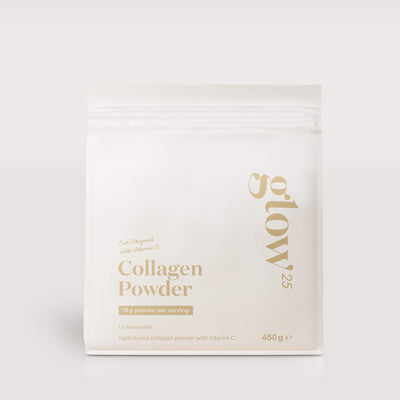
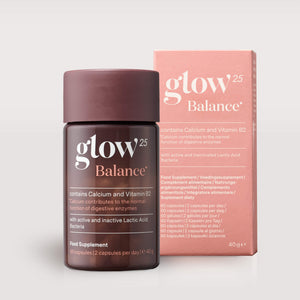
For getting started, the flavorless base powder is usually the easiest fit — stir it into coffee, a shake, or water. If you need something fast on the go or at the gym, pre-measured sticks are more convenient. And if gut health is also on your radar, a digestive-support product can round out the routine.

| Goal | What the studies show | Strength of evidence |
|---|---|---|
| Tendons & joints under strength training | Greater increase in tendon cross-sectional area in middle-aged men | Solid, but a single study |
| Muscle soreness after training | Reduced in men in their early 50s in a crossover trial | Promising, more research needed |
| Muscle building/strength directly | No added benefit over whey in a study of trained men | Mixed |
| Androgenetic hair loss | No scientific evidence of an effect | No evidence |
Frequently asked questions about collagen for men
Does collagen work differently for men than for women?
Collagen is chemically identical in men and women. Men's skin is on average somewhat thicker and more collagen-dense, since testosterone influences collagen density. But the age-related decline in the body's own collagen production affects both sexes.
Does collagen help with muscle building?
Collagen is not a complete protein for muscle building, since it lacks sufficient amounts of certain essential amino acids. Combined with strength training, however, it may support the recovery of tendons and connective tissue, as shown in a study of middle-aged men.
At what age should men start thinking about collagen?
The body's own collagen production starts to slowly decline from the mid-20s onward. Many men start supplementing in their late 20s, or considerably later, for example once joints take more strain from training — there's no one-size-fits-all starting age.
Does collagen help against hair loss in men?
For the most common form of hair loss in men, androgenetic (pattern) hair loss, there is currently no scientific evidence that collagen supplementation changes anything. Collagen may support general hair structure, but it does not replace a dermatologist's assessment.
Can I combine collagen with whey protein or creatine?
Yes. Collagen, whey protein and creatine are not mutually exclusive. Whey provides the essential amino acids for muscle building, while collagen is more geared toward tendons, ligaments and connective tissue. The two supplements serve different purposes.
Does collagen powder taste fine in coffee?
Yes. Glow25 Collagen powder with Vitamin C is flavorless and odorless and dissolves in warm drinks like coffee too, once the coffee has cooled to drinking temperature.
The bottom line
Collagen for men isn't a beauty fad, but it's not a muscle-building miracle either. The best-supported benefit is for tendons and connective tissue when paired with strength training, along with a possible reduction in muscle soreness. If you train regularly and want an easy, flavorless addition to your routine, collagen can earn a place in it — with realistic expectations, as a complement to training and a balanced diet, not a replacement for either.


